How Streaming Impacts Game Performance
Millions of players stream their gameplay every single day on platforms such as Twitch and YouTube. Does the dual focus on playing and engaging with viewers make streamers show lower performance? This study clarifies what's happening.
• On average, 1 million players stream their gameplay every single day on Twitch.
• Streaming demands additional cognitive resources, as the person is required to pay attention to the game and viewers.
• The average match duration for streamers is about 5 min. longer than for non-streamers, and those who play the most, having a low survival time (days), are more likely to play multiple games in a row.
• "... even if streaming has been shown to have an effect on the in-match engagement of players, this does not reflect on a direct effect on players’ win rates." [1]
• "... if a player has higher skills, his or her performance does not reflect the typical performance depletion pattern. This mechanism is indeed mitigated by the fact that higher skill players most likely can keep focus on the game for longer time while producing the streaming commentary at the same time." [1]
Streaming platforms, such as Twitch, play a pivotal role in the world of esports. A tremendous cohort of players broadcast their own gameplay live every single day. According to data from TwitchTracker, there are more than 1 million active streamers daily.
Part of the "job" of streaming is engaging with the viewers while playing. It can be argued that this engagement drains cognitive resources from the streamer, as reading comments, reacting to messages, and commentating demand attention and reactions. This may lead to streamers playing worse than they usually would or compared to non-streamers.
Today's study seeks to answer whether streaming takes a toll on performance and its connection to engagement in the game across sessions. To this end, the researchers took data from Riot Games' API and Twitch in 2018. The matches of 1,426 LoL streamers were analyzed, whereby matches they streamed and not streamed (94,000) were compared. In addition, the data from 2,168 non-streamers were collected in order to compare both groups.
🏃 Game Length, Performance, and Engagement
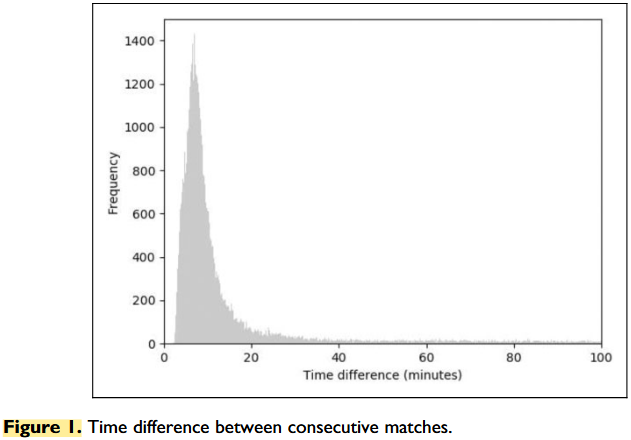
The first result showed that over 50% of the matches were played without an extended break of at least 1 h. As the figure below shows, the most matches are played in longer sessions—it's also a great example of a Pareto distribution (one of the most frequent distributions you can find), often used to show how wealth/money is distributed.
Second, the average match duration for streamers is about 5 min. longer than for non-streamers.
"When the Twitch users do not stream their videos, they tend to play shorter sessions than when they stream." [1]
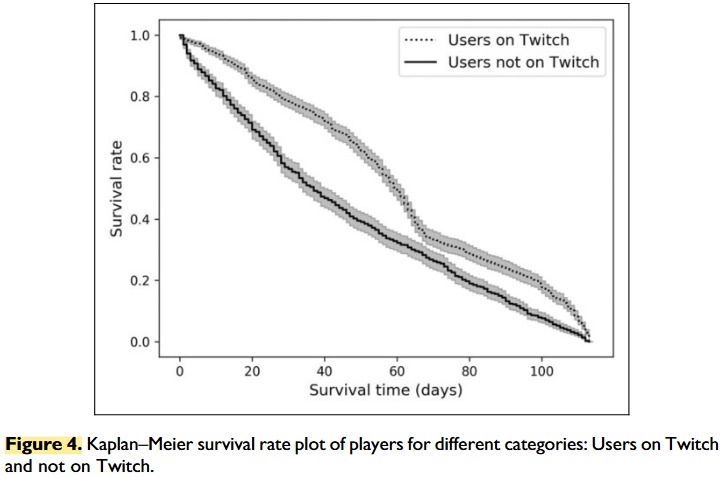
Similarly, non-streamers tend to have a lower rate of "just one more game" behavior. Meaning, "the probability that a user will play another match after the last one" [1]. Interestingly, as the figure below shows, those who play the most, having a low survival time (days), are more likely to play multiple games in a row.
Next up, performance. Here we go. Do streamers, compared to non-streamers, show a lower level of performance? Figure 5 shows the results.
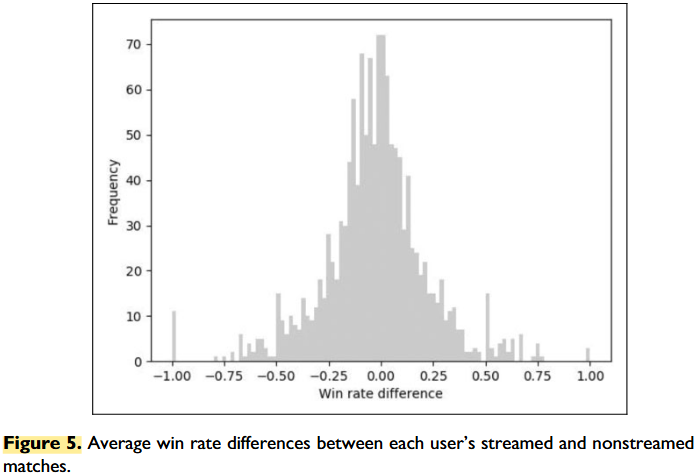
"... the distribution of win rate differences does not display any shift and it is instead centered around zero. Therefore, even if streaming has been shown to have an effect on the in-match engagement of players, this does not reflect on a direct effect on players’ win rates." [1]
So, weather someone is streaming LoL or not, performance doesn't seem to suffer from it. However, as pointed out before, players (especially streamers) who play in longer sessions without an extended break are more affected by the mechanism of session decay. Meaning, they'll play worse if they don't take a break of at least 1h. After checking with the data, this is exactly what the researchers found. Their performance suffers, but their win rate doesn't. But how?
"... if a player has higher skills, his or her performance does not reflect the typical performance depletion pattern. This mechanism is indeed mitigated by the fact that higher skill players most likely can keep focus on the game for longer time while producing the streaming commentary at the same time." [1]
Have a great Sunday/week, everyone.
Christian 🙂