Esportsmanship: How to NOT Behave in Esports
Esports has come a long way and is now professionalized at all levels. For example, the ESL Pro League rule books for Counter-Strike 2 have a combined length of 80 pages. However, there are unwritten rules that players (mostly) follow. Such rules fall into the category of (e-)sportsmanship. Today's study highlights what esportsmanship is and what behavior is perceived as unsportsmanlike in CS2.
• Sportsmanship can be defined as "a rule-based system with an ‘adherence to a body of written conventions and unwritten local norms shared by athletes, officials, and spectators in and around the sport’" [1].
• Sportsmanship in esports differs from traditional sports.
• "Unsportsmanlike behavior" means acting against "unwritten conventions agreed upon by players and spectators of the gaming community" [1].
• Such behavior in CS:GO includes exploiting bugs and match fixing but also less harmful acts such as refusing to handshake and mutilating the enemy corpse.
• However, such behavior always has to be seen in the context of the situation and relationship between players.
Sportsmanship has the potential to promote values (e.g., honesty, respect, trustworthiness, and honor). This is especially important as star players are seen as idols to younger generations, often mimicking their behavior. Sportsmanship can be defined as the following:
"a rule-based system with an ‘adherence to a body of written conventions and unwritten local norms shared by athletes, officials and spectators in and around the sport’" [1]
Sportsmanship in esports may differ from traditional sports for various reasons. First and foremost, esports takes place in a digital realm. Sometimes, unethical behavior is part of the game. For instance, in Eve Online, stealing and bribery are almost mandatory. In CS2, players shoot/kill others in order to win.
Unsportsmanlike behavior, on the other hand, is any behavior that has its base in "unwritten conventions, agreed upon by players and spectators of the gaming community" [1].
To find such instances of unsportsmanlike behavior in CS, the researchers watched 50 h (31 games in total) of CS:GO gameplay, including chat interactions. Afterwards, they interviewed 15 casual players that regularly watch major CS tournaments. Here's what they found.
🤝 I Refuse To Shake Hands
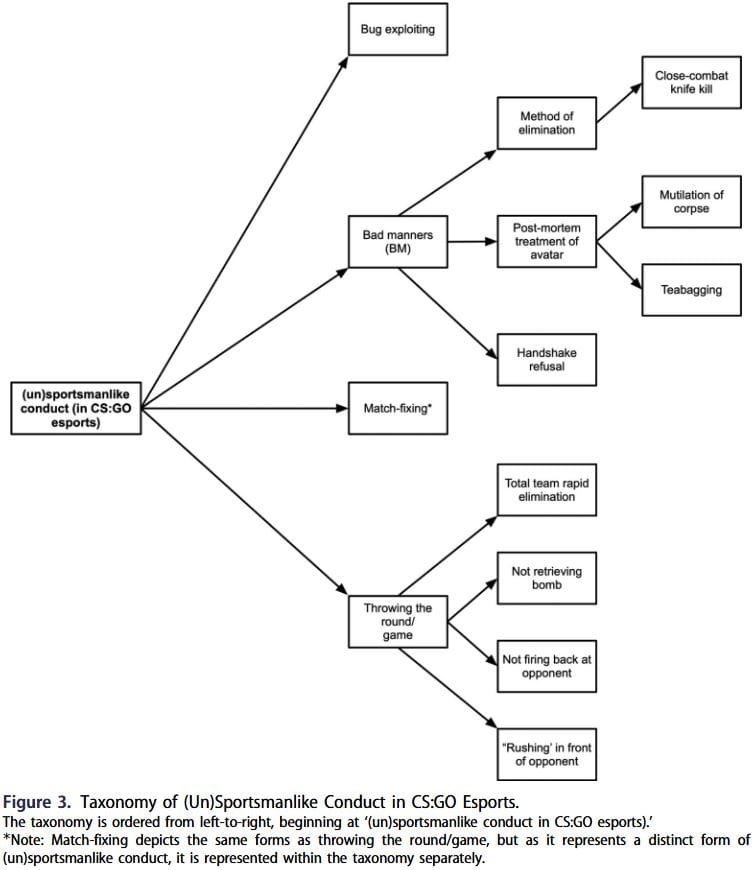
The figure above shows the unsportsmanlike conduct/behaviors in CS:GO. Things such as exploiting bugs, match-fixing, and throwing the game, found on purpose, are forbidden, however hard to prove. Hence, such behavior is agreed upon to be unsportsmanlike. Less extreme behaviors include refusing to shake hands after the match and the mutilation of the enemy's corpse.
"Depending on the context of the event and the relationship between players, teabagging can be interpreted as a signifier of closeness and intimacy between players." [1]
This notion can be extended. For instance, meeting your old teammate on stage that you're good friends with and refusing to shake hands, followed by a smile, wouldn't be seen as unsportsmanlike behavior but rather joking around. However, doing the same when your opponent is someone strongly disliked by the player, not shaking hands may be interpreted as being disrespectful and, hence, unsportsmanlike.
This was echoed by the interviewees, who stated that unsportsmanlike behavior, in their view, consists of a lack of respect for opponent(s) but also for their own teammates. However, "there are usually no hard-written rules saying that players mustn’t not respect others" [1]. Although this is true, some rule books state that players have to shake hands or fist bump after the match.
Have a great Sunday and start into your week. See you next Sunday.
Christian 🙂