How EEG Data Can Predict Game Outcomes
Wouldn't it be cool to predict the winner of a game BEFORE the match even starts? According to a 2024 study, this is what the researchers were able to do (with 80% accuracy). Here's how they did it.
• Predicting match outcomes using static player and match data is hard, but new dynamic approaches may have a strong predictive power.
• Pre-match EEG data were collected from 20 Grand Master Street Fighter V players.
• "... electroencephalography (EEG) data is recognized as a potent biomarker for the mental conditioning of players." [1]
• The best machine learning model achieved a prediction accuracy of 80%, with parietal beta activity being the most relevant feature.
• Such data and analysis pre-match have the potential to improve player and team performance through pre-match interventions.
With the rise of gambling in sports and esports, considerable efforts were channeled towards predicting the outcome of games. At the same time, athletes and teams try their hardest to gain an edge and improve their performance. A new path to do that is using machine learning models and real-time data.
"Previous studies have shown that the physiological condition in which players enter a match is strongly correlated with their subsequent performance or match outcomes." [1]
In plaine English: Knowing what's going on inside a player before the match is related to how the match will go. The idea is, rather than relying on static data, to use dynamic data of the athletes' conditions immediately before the match. "... electroencephalography (EEG) data is recognized as a potent biomarker for the mental conditioning of players." [1] EEG data produce an image of the player's brain activity (further below is an image).
"Pre-online-match EEG was recorded, with the ML models trained on obtained EEG data. We investigated the ability of ML models trained on EEG data to predict win and loss outcomes..." [1]
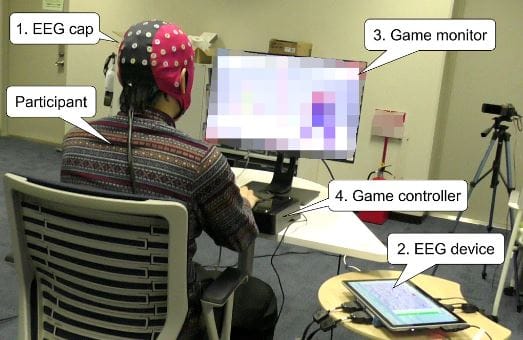
In doing so, the researchers had 20 participants (age 18-35) play ranked matches in Street Fighter V. All of them were Grand Master (top 0.26%). They played for about 3h over 3 days (~9h in total). The figure below shows the setup.
🧠 Pre-Match Brain-Draining to Improve Performance
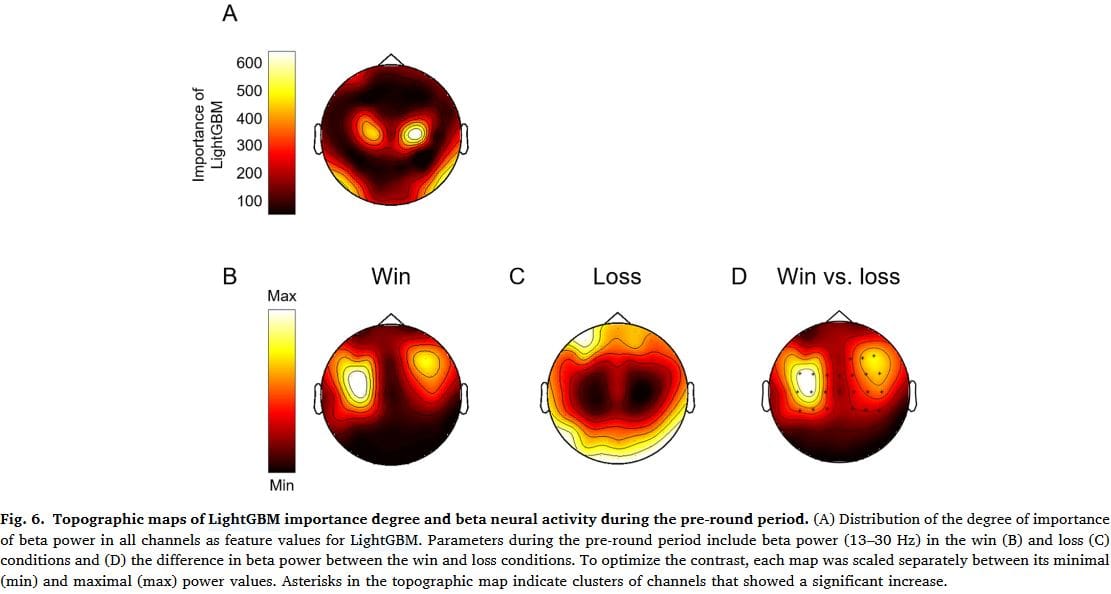
After using various machine learning models, the best one achieved a prediction accuracy of 80%, with parietal beta activity being the most relevant feature. The figure below shows the brain regions activated before the match that predicted the match outcome (win/loss).
In addition, the model results were consistent even in matches including upset situations (a lower-ranked player defeating a higher-ranked one). This is typically hard with traditional data.
"Predicting match outcomes with high unpredictability is difficult using traditional win/loss prediction methods because most datasets reflect static attributes, such as ball skills and in-game rank. [1]
However, it is worth noting that prediction accuracies of 60-95% were achieved in other studies using game information. The prime example is champ selection in MOBA games during the pick and ban phase. If two teams are similarly strong, the team who gets to play the "best" champs is more likely to win.
🥡 The Takeaway
There are some pretty cool things players, teams, and coaches could do with when collecting such data.
"EEG data is considered a potent biomarker for helping players and coaches ascertain their mental condition before a match." [1]
Just imagine, before an (important) match, the team collects each player's EEG data and runs the machine learning model. It figures out that the chances of winning are slim. What you can do now, as a coach or psychologically trained staff member, is to intervene and alter the "match-losing" EEG data and, ultimately, improve the player's/team's odds of winning.
I hope you guys enjoyed this episode. Read you next week. Best,
Christian 🙂