Listen To The Coaches! These Cognitive Skills Are Important For Esports
Cognitive skills are a major contributor to performance in gaming and esports. In studies, such cognitive skills and tests to measure them are always based on a specific theoretical viewpoint. This, however, completely ignores the perspective of practitioners such as coaches and players. Which cognitive skills are most important for performance in esports? Today's study asks professional esports coaches to understand the viewpoint of the experts.
• Cognitive skills relevant to esports performance are assessed using tests based on a theoretical perspective. This ignores the opinion of practitioners in the field.
• 51 professional esports coaches were surveyed, asked to rank the most important cognitive skills required in esports.
• Attention, reaction time, and timing emerged to be the top three.
• "... esports games typically last an average of 40 min, requiring constant attention on the progress of the video game, which might explain why esports coaches select attention as the most relevant cognitive skill." [1]
• Short-term memory and risk taking were the two least important.
Frequent readers know that cognitive performance plays a big role in gaming and esports performance. When studies investigate cognitive functions, they typically measure them using psychological tests. These tests are selected by the researchers from a specific theoretical perspective. This, however, completely ignores the practitioner's perspective.
Hence, today's episode focuses on the most important cognitive skills for esports performance, from the perspective of esports coaches. In doing so, 51 coaches participated. Each of them has at least seven years of esports experience and has completed a coaching course from an official esports federation.
"Their dual identity as former elite players and current coaches offers unique insights into the requirements of high-level performance." [1]
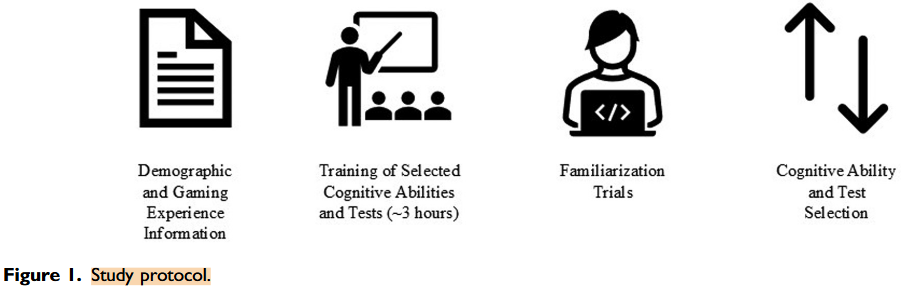
Before the coaches were surveyed for their opinion, they underwent a training of selected cognitive abilities and tests by the researchers and had familiarization trials with cognitive tests most often used in studies. The figure below shows the study protocol.
"Please select the three cognitive skills that you think are the most relevant ones regarding the in-game dynamics of the esports game you are interested in, and list them in order of their importance." [1]
In the survey, the coaches had to rank the seven cognitive skills to indicate their importance for esports performance in their specific esports title. The options were: "(a) simple reaction time, (b) inhibition, (c) attention, (d) timing, (e) short-term memory, (f) cognitive flexibility, and (g) risk-taking." [1]
Before moving on the results, how would you rank them? What are the top three cognitive skills that you think are most important for gaming and esports?
👀 Attention! Eyes Glued to the Screen
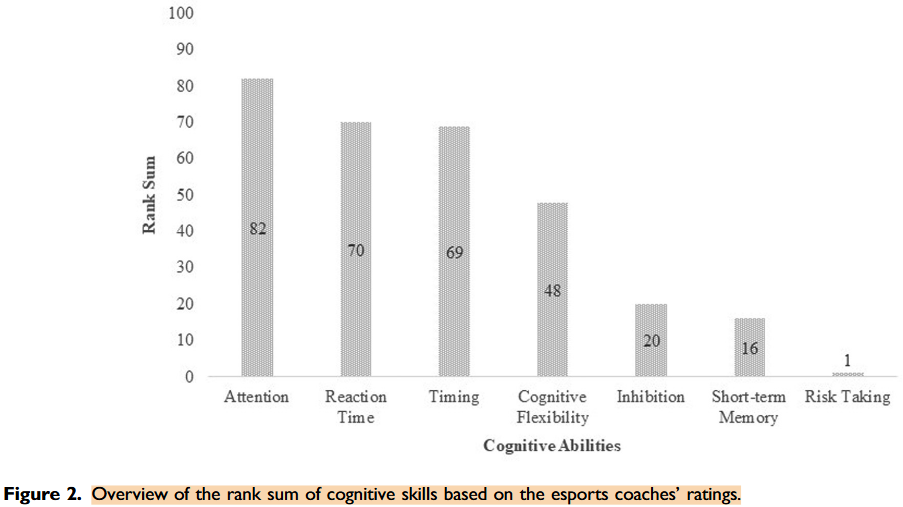
As you can see in the figure above, results from the 51 coaches show that attention, reaction time, and timing are the top three most relevant cognitive skills for esports performance. On the other hand, inhibition, short-term memory, and risk-taking are not very important.
"... esports games typically last an average of 40 min, requiring constant attention on the progress of the video game, which might explain why esports coaches select attention as the most relevant cognitive skill." [1]
With regard to reaction time, this should be easy to go figure out. If you're a slow boomer in games such as Counter-Strike, StarCraft, or League of Legends, you won't get high up the ranks. Especially FPS games heavily rely on recognizing someone jumping around the corner and being able to react to it.
Interestingly, risk-taking basically isn't relevant at all. The researchers didn't give an explanation as as to why this may be the case. I assume that most esports titles and professional teams train their players to play very methodically and "cleanly." Meaning, they are supposed to follow the game plan and what was learned during training and preparation for the enemy team. In other words, no team wants a player who repeatedly rolls the dice in a game to risk it all, screw up the strategy, and throw their team mates into the blue.
Have a great week, everyone.
Christian 🙂