
Violent Games and Crime Rates

It's cool to be a criminal in-game. Violent video games were shown to drive aggression. But is this also true for the crime rate? Today's study analyses a dataset of 50+ million crimes and its relationship to playing violent video games.
• Violent video games today are top-selling games.
• Multiple studies have shown that playing violent video games increases aggressive behavior.
• "For the under-17 group, the increases in crime are driven by increases in violent (10.74%), drug (15.26%), and property crimes (3.15%)—the same types of crime that are treated as routine and trivial in violent video games." [1]
• For those over the age of 17, the magnitude was lower.
• In states where alcohol is easily available, crime rates are higher.
Between 2008 and 2018, consumer spending on video games has tripled. The majority of the spending went towards violent video games. For example, the best-selling game in 2005 was Madden NFL 06, and FPS games made up only 8.7% of unit sales. Just 13 years later, in 2018, the best-selling game was Call of Duty: Black Ops 4, and FPS games made up roughly 20% of unit sales.
A meta-analysis of 136 studies with over 130,000 participants found that the “exposure to violent video games is a causal risk factor for increased aggressive behavior, aggressive cognition, and aggressive affect and for decreased empathy and prosocial behavior.” [1]
Another meta-analysis reported that playing violent video games was linked to higher levels of overt physical aggression over time, even after accounting for prior aggression. These studies, however, examined aggression and not crime. So, today's study did exactly that by investigating the changes in crime in the weeks following the release of top-selling video games between 2006 and 2011.
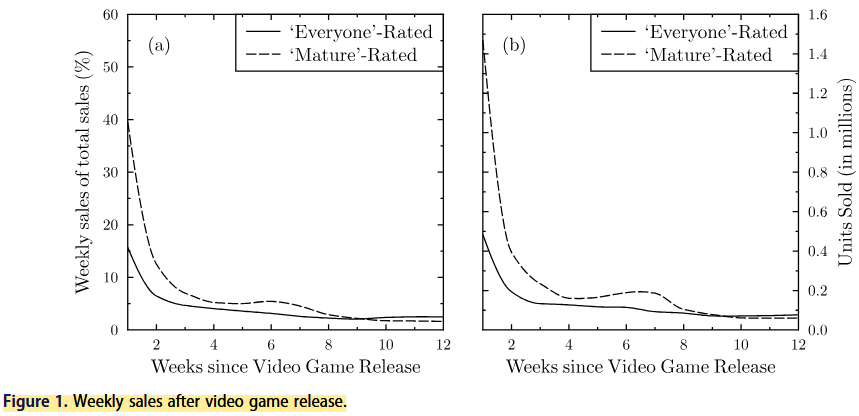
The researchers took data from games that exceeded 1 million units sold, as well as the crime dataset from the NIBRS (National Incident-Based Reporting System) in the US. With that, they analyzed data on violent outcomes from 50+ million individual crimes across 35 states, not just aggressive behavior. The figure below shows the sales of video games over multiple weeks.
🕵️♂️ I Play Games, I am a Criminal!?
"For the under 17 group, the increases in crime are driven by increases in violent (10.74%), drug (15.26%), and property crimes (3.15%) – the same types of crime that are treated as routine and trivial in violent video games." [1]
That's quite something, huh? Especially if you think about the fact that those 17 or below shouldn't play these violent games in the first place, at least according to the industry self-regulator. On top of that, the increase in crime following the release of a violent video game is positively related to the number of sales. Meaning, violent video games with greater sales induced larger increases in crime.
Another finding was that, for the age group of 17 and older, there were also increases in some of the categories, but the magnitude was much lower (drug crime increased by 2.74%).
Interestingly, the results are also driven by crime in states where alcohol is easily accessible. The researchers suggested that either individuals in "dry states" (where alcohol sales are restricted) are not exposed to violent video games as much, compared to their peers in other states, or when alcohol joins violent video games, the result is a higher crime rate.
Hope ya'll enjoyed the episode. Sorry, for the late post, but I couldn't publish it earlier.
Christian 🙂