Young Players Exit Esports Early
Esports is a grueling industry for young players. The majority exists in the professional scene early. But why? What conditions are they met with that have them quit? What does their career trajectory look like?
• Young esports players who often work under harsh conditions can experience burnout and put an early end to their careers.
• The median age of competitors has climbed in recent years, and the age range has widened.
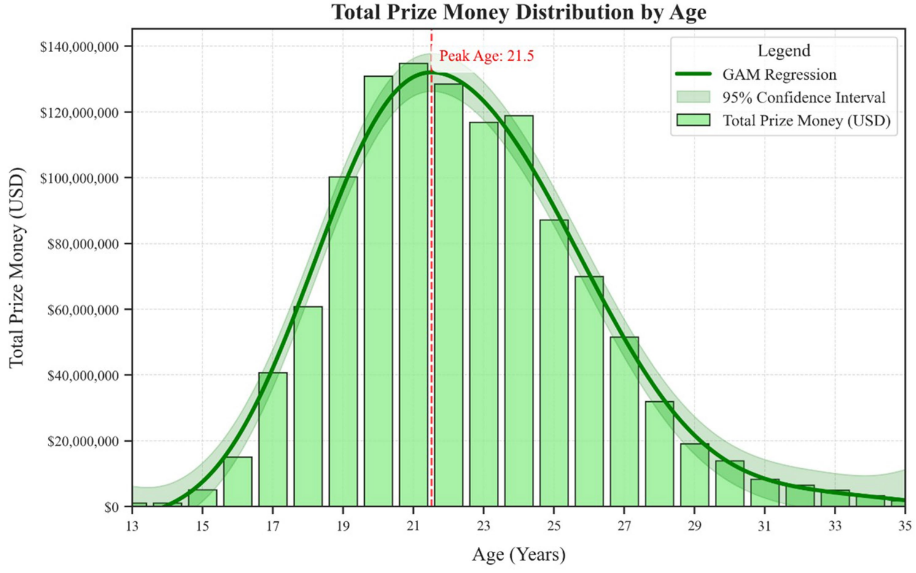
• Players are most active at the age of 20.8 and earn the most at age 21.5.
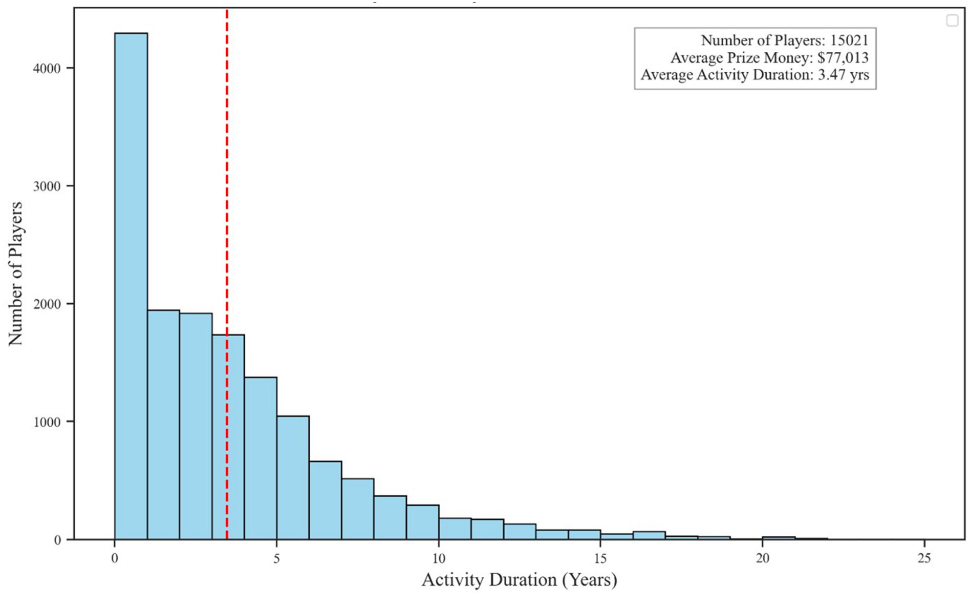
• The average career length was 3.4 years with an average earnings of about $77,000.
• Younger players are confronted with the potential of higher gains but face intense competition, and "players are reaching higher peaks faster but also encountering burnout and career instability more frequently" [1]
"At just 15 years old, many aspiring esports prodigies are already practicing upwards of 10 h a day, driven by the promise of fame and fortune—yet, many find themselves sidelined or burned out before they even turn 20." [1]
Esports is a grueling industry that works under the law of supply and demand. Many young players today play video games for many hours per day. Some of them want to make it their job. At the same time, there are only so many high-level teams in need of new players. However, the turnover rate (how fast one player is replaced with a new one) is quite high. Part of it is that, once one player doesn't perform well anymore, there are hundreds waiting to take over his position.
"Young competitors, often minors, routinely log excessive practice hours, sign contracts with inadequate safeguards, and face volatile working conditions that can heighten mental stress and physical wear." [1]
Another aspect that is unique to esports is the power of publishers. Publishers can unilaterally modify game mechanics, change the tournament structure and rulebooks, and change the competitive format. This kind of uncertainty is another factor that drives instability and affects player careers regardless of skill or dedication. To exemplify, I bet every one of us played a game patch that felt "just right." Once a new patch hit, we couldn't really get the hang of it and ranked way lower than we did during the previous patch. Now, imagine your job depends on it.
At a lower level, the landscape is even more fragmented when it comes to conditions for players. Universal safeguarding measures are often absent, and semi-professional or academy-level tournaments are overseen by no established body. Hence, standards for player contracts, working conditions, and youth protection measures vary dramatically.
"Young competitors—often minors—are particularly vulnerable to the effects of inadequate rest, erratic practice schedules, and minimal health resources." [1]
These conditions, combined with long practice schedules (10-14 h per day), can lead to chronic physical issues, such as pain in the wrists, lower back, and neck, and ultimately burnout. Unlike in traditional sports, young athletes rarely have access to a structured physical support system with rest protocols, physiotherapy, etc.
Don't forget about the mental aspect. Constantly competing under, partly, harsh conditions, as well as high pressure from the public—live streaming and social media.
"Young players often face performance anxiety, social isolation, and a pervasive fear of failure, which can precipitate early burnout." [1]
As a consequence, the career of young esports athletes may end sooner than it could be. Many competitors enter the professional stage in their late teens or early twenties. Most of them leave after two or three competitive seasons. The reasons mentioned above are a crucial part of it: fragmented governance structure, long practice hours, gaming-related health issues, competitive environment, and performance issues that can easily lead to the termination of the contract.
After this longer than usual introduction, let's examine what the study found with regard to the career trajectory among esports athletes and the role that negative factors play in accelerating burnout. The researchers analyzed 15,021 unique player data. Get ready for a lot of charts.
🥵 I'm Burning... Out
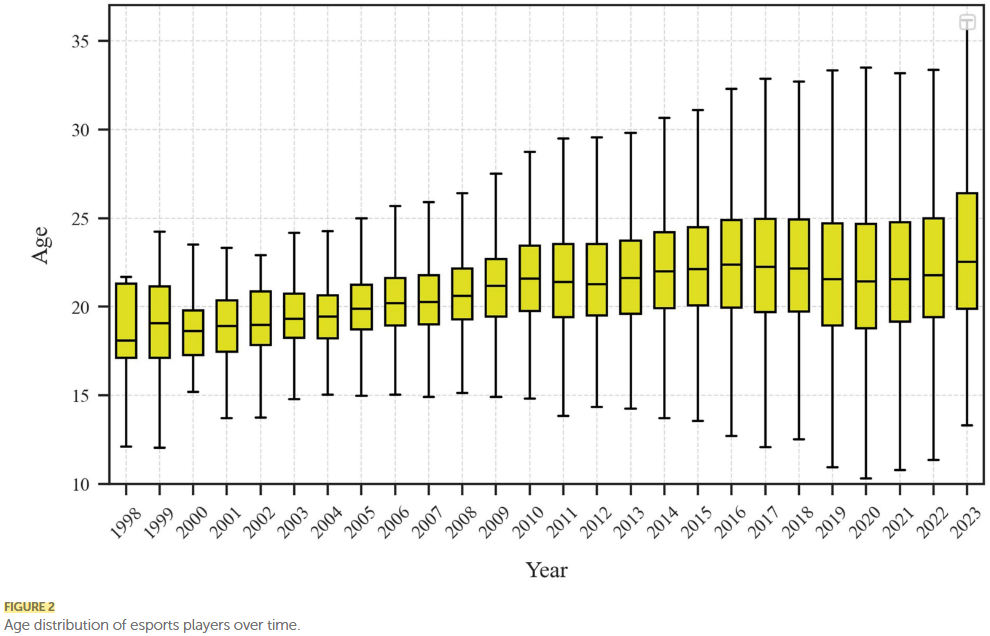
The first chart below shows the evolution of age distribution among esports players from 1998 to 2023. Between 1998 and 2006, the median age was around 18-19, with a narrow range and just a few outliers. From 2007 to 201, the median age climbed to about 21, and the upper age range widened towards the late 20s, even early 30s. From 2016 onward, the media age stabilized around 22, and the age range widened. This means that older players (late 20s) stay active longer, and young players still dominate the scene.
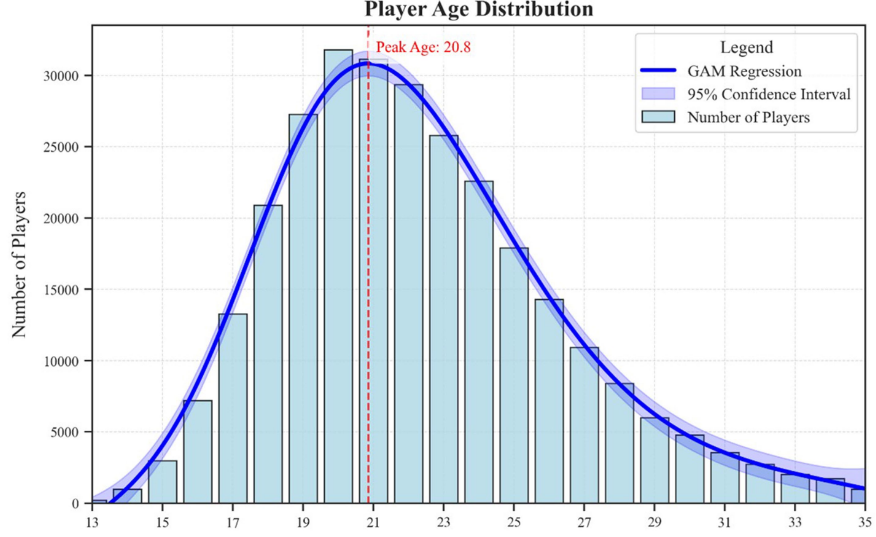
The second result the researchers found was that the peak of the frequency of competitors was around 20.8. Meaning, that's when players are most active. The figure shows the prize money by age, and its peak is around 21.5, indicating that the maximum earning potential lags behind about one year when players are most active.
Now, let's have a look at the overall distribution of career lengths. The average hovers around 3.4 years; most players exit the professional scene within the first or second year. It shows a "beautiful" Pareto distribution. Only a minority survive and stay in the scene for long. I suspect that the majority of players give esports a go after college for one or two years. If they don't make it into the professional scene, they leave (e.g., for monetary reasons or college).
In sum, the results show that younger players are confronted with the potential of higher gains (money and fame) but face intense competition compared to the OGs (who are in their 30s and 40s now). Furthermore, "players are reaching higher peaks faster but also encountering burnout and career instability more frequently" [1].
On the bright side, some well-funded organizations do have support teams and a culture that sees the players as a partner instead of an easy-to-replace labor unit. However, that's only at the top level.
I hope ya'll enjoyed the episode. Read ya next Sunday.
Christian 🙂

References
[1] Kang & Kim, 2025