How Video Games can Help People with Major Depressive Disorder
Research has shown that video games can hold many benefits and satisfy various human needs. This may extend into the realm of people diagnosed with major depressive disorder. In today's episode, we'll be looking at a study that examines how video games may improve depressive mood, visuo-spatial abilities, and motivation.
• Video games may be utilized as a therapeutic tool for people with major depressive disorder.
• A group of depressed individuals underwent a six-week intervention with at least 18 sessions of playing Super Mario Odyssey for >45 min. each.
• Results show a significant decrease (about 40%) in depressive symptoms, higher compared to two control groups.
• The researcher suggests that video games decrease rumination (a spiral of negative thoughts), linked to depression.
• Video games satisfied basic psychological needs and motivated participants to stick to the training.
"The study of the human mind and behavior can be subdivided into two broad categories: the cognitive – “how we know the world“and the affective – “how we feel about it.”" [1]
Both categories, cognitive and affective, interact and depend on each other. Meaning, cognition can affect emotional well-being and the other way around. Major depressive disorder (MDD) is just one example of a mental health disorder that is associated with low mood, low motivation, and cognitive impairments (e.g., poor memory functions).
In recent years, research has focused on how immersive video games can be utilized as therapeutic tools in many health-related areas. Why is that? Frequent readers know that playing video games has a multitude of benefits, including increased visuo-spatial memory abilities. Especially action video games have been shown to be a good leverage to increase attention allocation, cognitive control, enhanced mental rotation abilities, and spatial skills.
Today's study links both—MDD (major depressive disorder) and action video games. The goal was to find out how video games may affect depressed mood and motivation in people with MDD. To find out, they analyzed data from 46 participants, creating three groups. Group 1 was the group playing video games for six weeks, each session of at least 45 min. Group 2 was an active control group (training with a cognitive training program), and the third group were those who underwent treatment-as-usual. In case you're wondering, the video game played was Super Mario Odyssey on the Nintendo Switch.
🎮 Playing for a better Mood and Motivation
The most important finding of the study is highlighted in the figure below. As you can see, depressive symptoms in people with a diagnosed major depressive disorder decreased by about 40%, making it a significant finding. Although the depressive symptoms also decreased in the two other groups, the results weren't significant in this study.
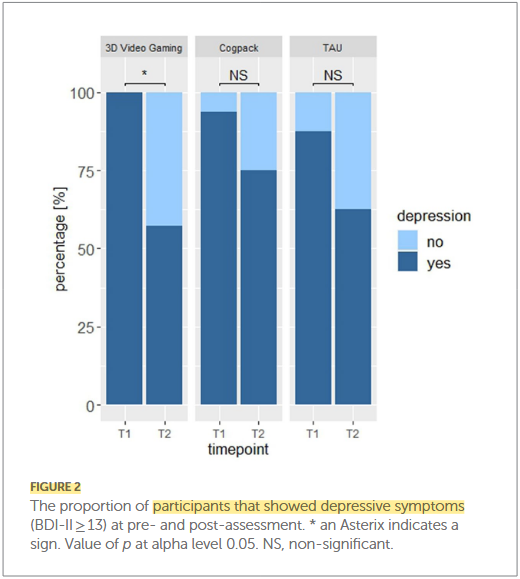
"These findings suggest that the addition of video game training to regular treatment including psychotherapy and/or pharmacological treatment can lead to reductions in depressive symptoms."
Interestingly, a core symptom common in depression is an increased level of rumination. Rumination is a type of repetitive negative thinking pattern. Think of it as a spiral of negative thoughts that's hard to break out from and has been linked to prolonged and exacerbated emotional states as well as worse cognitive function. The researchers, in light of the study's findings, suggest that the reduced depressive symptoms stem from decreased rumination. But why would that be?
First, video games are more motivating than other forms of training. Training is work, and gaming is fun. So if you're given the choice to work or play a video game... I guess most people would choose firing up a game.
Second, they are fun and entertaining. With fun and entertainment comes positive emotions and increased emotional investment.
Third, depressed individuals often feel a lack of control over their lives. In video games, they get to make choices in a safe and controlled environment. Hence, they can be empowering and motivating. In this sense, they satisfy basic psychological needs for autonomy, relatedness, and competence. Autonomy, for instance, would be choosing which quest to go on or to design the character to your liking. Relatedness can be thought of as playing with or against other people, bounding with them. That's one of the reasons why we enjoy using voice comm and talk to our buddies while gaming. Competence includes facing skill-graded challenges and positive in-game feedback (e.g., mastering something).
Lastly, I should also mention that the video game group did not significantly perform better than the control groups in the visuo-spatial memory test.
Thanks for the read! See you next Sunday,
Christian 🙂