What is a Gamer?
Millions of people worldwide play video games. People that consider themselves gamers. But what exactly is a gamer? How is it different from casual players and esports players? Today's study developed and tested a scale to get a more clear picture.
• Millions of people worldwide play video games and consume gaming-related content.
• It is unknown what a "gamer" is and how gamers are different from casual gamers and esports players.
• A scale was developed, tested using data from 576 individuals, and analyzed.
• The scale consists of nine items.
• Higher scores are associated with more gaming-related activities, time spent gaming, and being a member of an esports team or club.
In a 2021 survey, 226.6 million Americans were estimated to play video games at least once per week. About half of them averaged over 7h of gaming each week. 80% of US gamers are aged 18 or older, with an average age of 31 years. In the same year, platforms such as YouTube and Twitch streamed live video games to an audience estimated 728.8 million worldwide. So yeah, gaming is a thing, we all know that.
With such high numbers, it would be great to know what a gamer actually is. What distinguishes casual video game consumers from those who are deeply involved in video games? From a more scientific perspective, studies so far have just either asked people if they play video games or if people considered themselves gamers (whatever they, themselves, thought this meant). The same problem applies to identifying esports players.
So, today's study focuses on this problem. The goal was to come up with a reliable scale to more accurately measure distinctions between gamers, esports players, and casual gamers. To do so, they first developed an initial set of items (questions) by working with three professors and Ph.D. students that all research gaming and esports, as well as three varsity members of a university esports team or club. Then, the scale was tested, surveying 576 players.
🎮 REAL Gamers
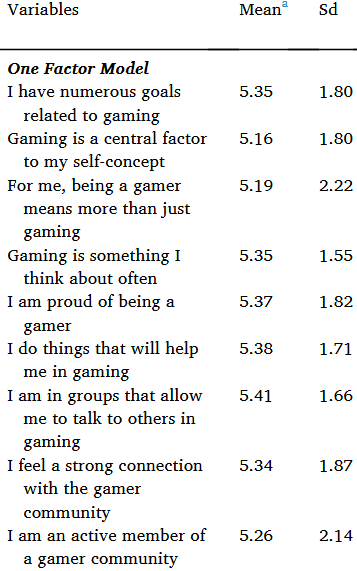
According to their findings, the gamer identity scale consists of only nine items, making it a short and easy-to-use tool for researchers. You can see the scale below, including the items, mean scores, and standard deviation.
On top of developing and testing the scale, the researchers did some additional analysis.
"Results indicated that gamer identity was associated with age, behavioral intent (i.e., intent to play video games, interact with other gamers, watch streaming video games, etc.), time spent playing video games (i.e., minutes per day), and membership with an esports club or team." [1]
Specifically, individuals with high scores on the scale had a greater intent to do more game-related activities and spend more time playing (who would have thought?). Also, the higher the score, the higher the likelihood of being a member of an esports team. Also, not a shocker. The scores also increased the older the participants were, meaning the more time they had (age) to spend on gaming and gaming-related things, the more they strengthened their connection to gaming and identified as gamers.
Thanks for reading, and I hope you all have a great week. Best,
Christian 🙂

References
[1] Yim et al., 2023