Are High-Level Gamers more Attractive?
Playing video games has many impacts on each gamer's life, such as health, well-being, skill, and friendship, just to name a few. One that is rarely in the spotlight is attractiveness, as part of others' social perception. Today's study examines how social knowledge (in-game rank) affects how attractive someone is rated by gamers and non-gamers.
• "... facial attractiveness plays an important role in social interactions. It not only influences mating preference and social assessments of age and health... but also has strong influences on social interactions." [1]
• "... participants tended to give facial images with high gaming-skill information higher attractiveness ratings than facial images with low gaming-skill information." [1]
• "Game-players might perceive higher gaming skills as more positive than non-players." [1]
• Participants without gaming experience, the information on gaming skills did not influence how attractive they rated someone.
• Non-gamers rated feminized female faces and masculinized male faces as more attractive compared to the gamer group.
Playing video games has many impacts on each gamer's life, such as health, well-being, skill, and friendship, just to name a few. One that is rarely in the spotlight is attractiveness, as part of others' social perception. Let me explain.
"... facial attractiveness plays an important role in social interactions. It not only influences mating preference and social assessments of age and health... but also has strong influences on social interactions." [1]
Furthermore, people with positive personality characteristics are consistently given higher attractiveness ratings compared to people with perceived negative ones. Now, in the context of gaming, gaming skill (the level of expertise someone has), such as in-game rank, could be such a personality characteristic. "For example, we might believe that players who are good at competitive games have higher competence" [1]. Some may know this as the infamous Halo Effect.
In this sense, if someone knows your gaming skill (in-game rank), players with higher ranks should be given higher facial attractiveness scores, right? That's what today's study focuses on.
"... would people (players and/or non-players) think high-skilled video game players are more good-looking or less good-looking?" [1]
Another factor that is known to affect the evaluation of facial attractiveness is sexual dimorphism—when males and females have different physical traits, in this case facial features. Studies have shown that "female faces with more feminine features are perceived as more attractive than female faces with more masculine features" [1].
Moreover, male faces are ranked even more attractive when information about their competence is added. Interestingly, the exact opposite is the case for women—a higher perceived competence level makes them perceived as less attractive. This may also be the case in our case: facial images paired with high-gaming-skill information should make male faces look more attractive and less for women.
In total, 314 people participated in the study. Participants were then split into four groups: gamers and non-gamers, and high-level and low-level gaming skill information was added to the pictures. The game they chose to add as competence information (in-game rank) to the facial images they showed to people was League of Legends (what else, right?). The ranks were split into two: High-skilled rank (Challenger to Platinum 3) and low-skilled rank (Silver 3 to Iron 4). The faces were also feminized and masculinized to create the illusion of sexual dimorphism. In other words, each image had two versions, the masculine version and the feminine version. The image below shows an example from the study.
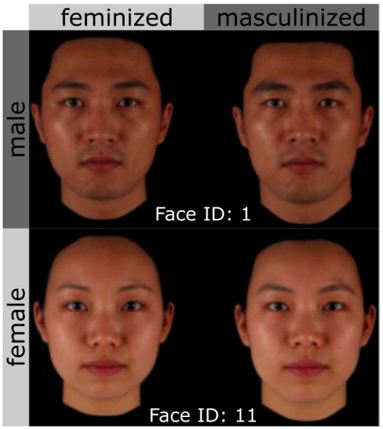
Here's how the experiment went. Each participant was asked to rate the attractiveness of some LoL "players'" faces. I put players in quotation marks because the people displayed weren't really LoL players—that's just what they told the participants. Each face was displayed along with the gaming skill information (in-game rank). Participants always saw 4 blocks: "male masculinized block, female masculinized block, male feminized block, and female feminized block, each block containing 10 face images." [1]
🎮 I'm Gaming, Therefore I'm Attractive?
"... participants tended to give facial images with high gaming-skill information higher attractiveness ratings than facial images with low gaming-skill information." [1]
According to the researchers, this suggests that positive social knowledge (having information about the people's in-game skills) can increase attractiveness ratings. Another interesting finding was how each group (gamers and non-gamers) rated faces. The results show that there was a significant difference between high-gaming-skill faces and low-gaming-skill faces in the group of gamers (those who played LoL). In the non-gamer group, the effect was also significant, but only marginal. The effect was that...
"Game-players might perceive higher gaming skills as more positive than non-players." [1]
In plain English: participants without gaming experience, the information on gaming skills did not influence how attractive they rated someone. As suggested by the researchers of the study, how much someone values social knowledge (gaming skill) may be influenced by individual experience or value judgement. This makes sense; if you spend time on something, you likely perceive it as good and valuable. You likely also have a more positive view on people if they have the same interests as you. Also, if you know how hard it is to achieve something (e.g., in-game rank), you have a better perception of someone who achieved the same thing.
What about sexual dimorphism (female-masculinised faces, male-femininised faces...)? The study found that sexual dimorphism effects only appeared in the group of non-gamers.
"... non-players rated masculinized male faces as more attractive than feminized male faces, and rated feminized female faces as more attractive than masculinized female faces." [1]
For game-players, they gave similar attractiveness ratings, independent of genders, and displayed gaming skill. The researchers speculate that the lack of knowledge in gaming means non-players aren't able to infer personality characteristics from the information of in-game ranks. Consequently, their ratings are influenced to a higher degree by how masculine or feminine faces look. Another speculation is that...
"In contrast, LOL players might consider themselves to belong to the same social group; therefore, when LOL players evaluate other LOL players’ facial images, due to the in-group favoritism effect." [1]
Thanks for reading, and I hope you all have a great week. Cheers,
Christian 🙂

References
[1] Li et al., 2023