
The (Hidden) Drug Problem in Esports Competitions
In sports, players are constantly tested for illegal substance use. However, is this also the case in esports? What is the current state of the industry? Do players take drugs during competitions? The answer: yes!... But there is more to it!
• Major esports organizations are criticized for having severe deficiencies regarding tests for doping and substance abuse.
• Players reported taking drugs mainly to improve their performance but also to tackle anxiety and external expectations.
• Between 11.4% and 15.3% of players reported using illicit or prescription drugs during tournaments at least "sometimes."
• However, according to them, match-fixing, cheating, and gambling/betting are more of a threat to the integrity of esports tournaments than substance (ab-)use.
• Valve bans players for cheating or match-fixing, but not for using any of the named substances.
Although esports has become more sports-like, there are some areas that lag behind traditional sports. One of those areas is doping. In 2016, many esports organizations, such as BLAST and EFG (ELS FaceIt), partnered with the World Anti-Doping Agency. However, they have been criticized for having severe deficiencies.
Similarly, Valve (the publisher of Counter-Strike and Dota 2) pulled their support from their 2020 The International (TI) tournament after the Philippine legislation classified esports athletes as professional sports players, requiring them to undergo drug tests before competing in the country. Valve justified their move by arguing that this was an unreasonable infringement on the privacy of the players.
So, it appears that the esports organizations are not much interested in this topic. But what about the players themselves? Is doping an actual problem in esports or not even a blip on the radar? How do they feel about this, and what are their experiences?
To investigate these questions, the researcher of the current study asked Dota 2 players. 255 answered the questionnaire (most of them casual players). 75% reported not making any money from esports, 8% earned up to 499permonth,andtherestatleast499permonth,andtherestatleast500. 1% of them reported earning more than $5,000 per month.
Prescription drugs include components of, e.g., Ritalin and Adderall, but also illicit substances such as cocaine and amphetamines.
💊 I've been poppin' Pillies Man I feel just like an Esports Star
35% of players stated that drugs such as Ritalin and Adderall are illegitimate. 89% of those who take/took drugs indicated that they did it to improve performance. 68% did it to tackle anxiety and in response to external pressure and expectations (64%). Interestingly, 57% said that the actual lack of anti-doping regulations was their motivation to take drugs. 40% had the perception that since everyone is using it, then why not.
"However, the results still indicate a remarkable prevalence of infrequent use of illicit substances and prescription drugs, ranging from 15 to 23%." [1]
Let's have a look at the usage rate of performance-enhancing substances. This also includes caffeine, energy drinks, and nicotine.
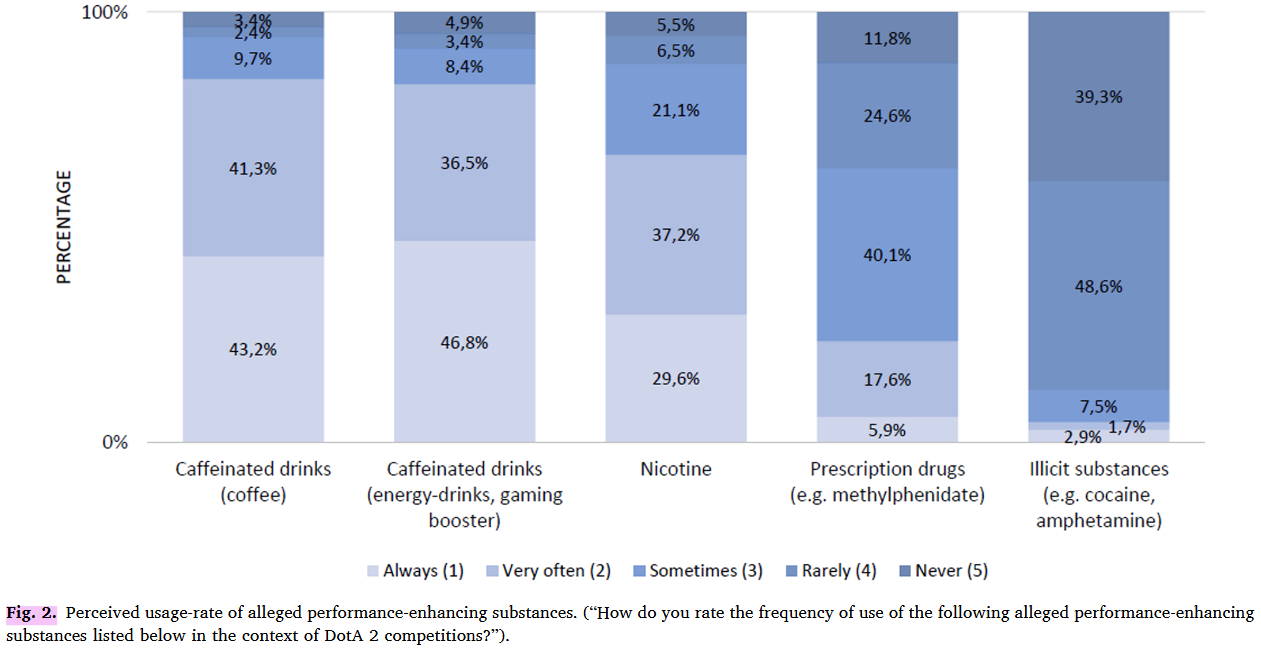
The figure shows the participants' perception of the usage rate during Dota 2 competitions. Interestingly, almost 18% think (or know?) that prescription drugs are sometimes used in tournaments, while for substances such as cocaine and amphetamine, it's 7.5%. Also, these two categories of drugs are always used between 2.9% and 5.9%. But what about the actual usage? Here's what the participants reported.
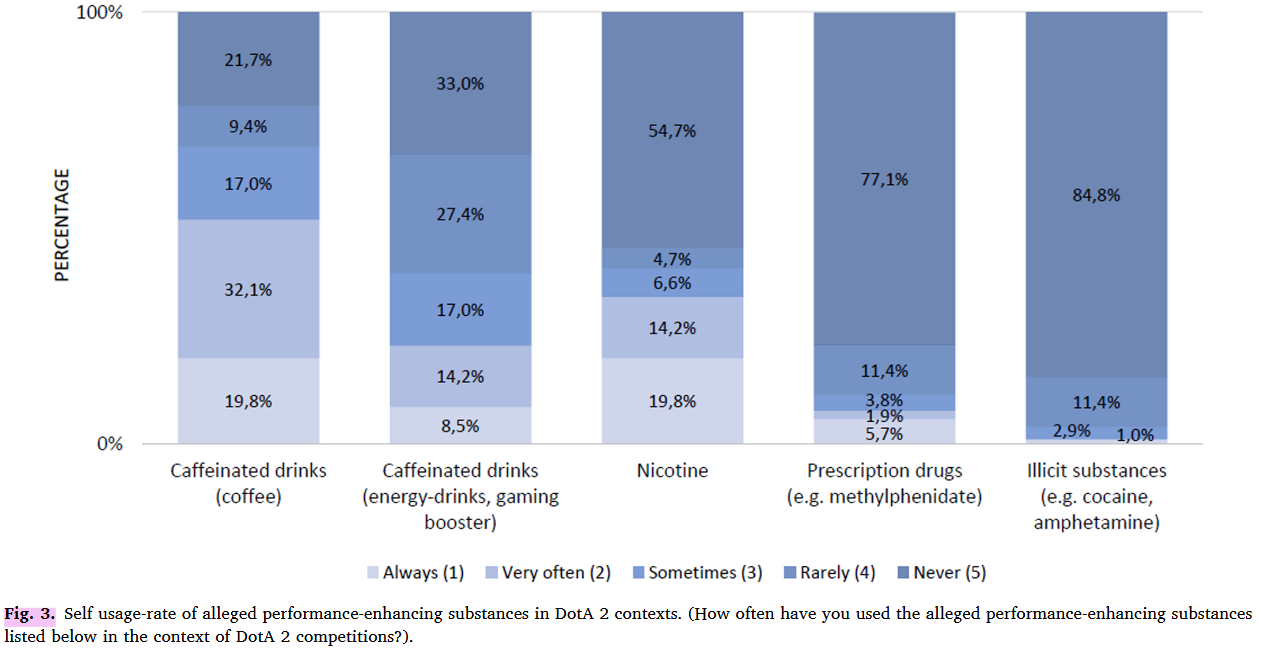
As you can see in the figure above, 5.7% of them always use prescription drugs, and 1% illicit substances. When adding up always, very often, and sometimes, it's 11.4% for prescription drugs, and 15.3% for cocaine, amphetamines, etc. In a team sport, that's massive. When considering major tournaments, there are quite a number of players doing any of these substances.
However, when it comes to the integrity of esports tournaments, it's not actually that big of a threat, according to the participants. Match-fixing, gambling/betting, and cheating are perceived as being more important than taking action against doping (see the figure below).
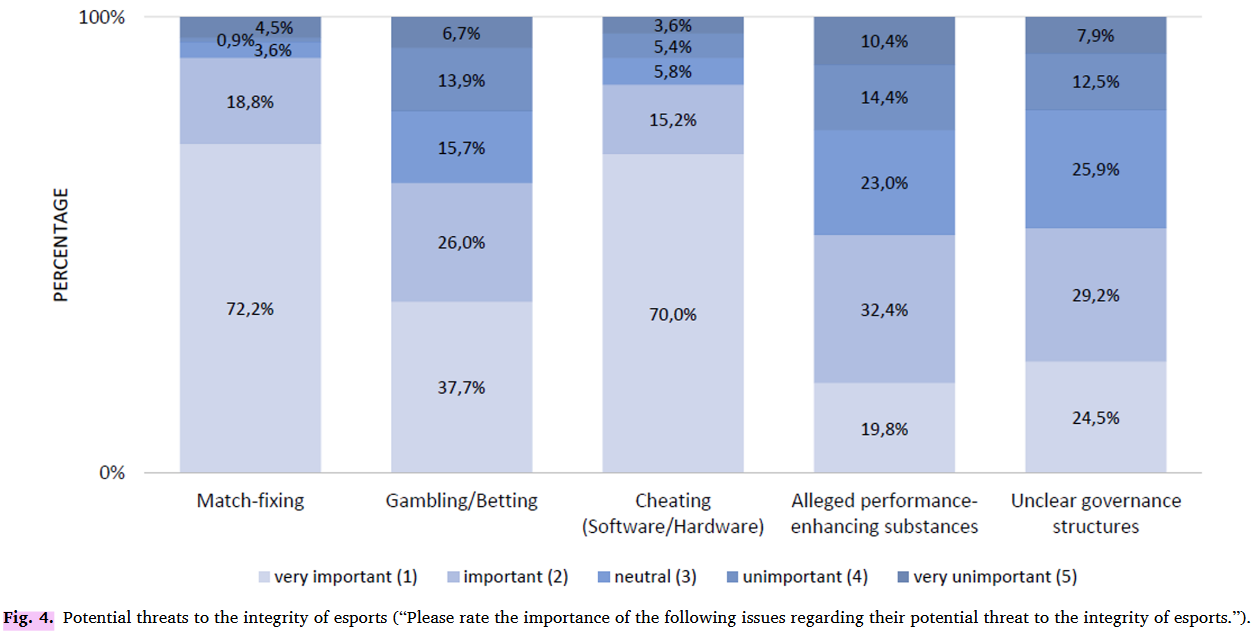
This may also explain why companies are more focused on these three subjects as well. The media, fan, and player base would be much more upset about a case of match-fixing, cheating, or gambling (well, probably not anymore since esports lives off of gambling) than some player or team doing drugs. Worst case, the player, team, or organization is just gonna get banned (easy fix).
However, if you look at the history of Dota 2/Valve, players are actively banned for match-fixing and cheating, but not for substance use. Also, you can't ban anybody for substance use if you don't test in the first place.
🥡 The Takeaways
If you watch any esports tournament where there is a somewhat decent amount of money on the line, you can assume (according to the data of the study) that multiple players are taking some sort of illicit substances or prescription drugs. I hope this doesn't ruin your viewing experience forever.
Thanks for reading, and I hope you all have a great week.
Christian 🙂