Play, Watch, Drink: How Esports Advertising Shapes Gamer Habits
The gaming and esports audience has grown massively in the past decades, presenting an attractive opportunity for companies to advertise. Especially gambling, nutrient-poor, energy-dense, and alcohol products are advertised. But do these ads actually impact gamers? If so, do heavy and addicted gamers differ from other gaming cohorts?
• With the growth of gaming and esports, advertising becomes an attractive opportunity for companies.
• Especially nutrient-poor and energy-dense foods, as well as alcohol and gambling predominantly sponsor esports.
• How does the advertising of alcohol in esports impact consumers (the average gamer)?
• Between 21.7% and 53% of gamers are likely addicted to gaming.
• The advertising of alcohol is linked to a more positive view on alcohol and consumption while playing and watching esports, especially heavy and addicted gamers.
"With esports audiences rapidly growing, companies are focusing on monetising this audience. Esports represent an attractive opportunity for companies, traditional sports, and entertainment organizations keen to engage with valuable millennial and Gen Z consumers." [1]
Most gaming and esports content is consumed via platforms such as Twitch and YouTube. Due to the long hours people watch gaming-related content, companies have a long-lasting gateway into the brains of (potential) consumers. If you watch an esports tournament, it typically spans across two to three days of at least 6 hours per day. Within these 18+ hours, you are exposed to brands and their products.
A recent review found that sports sponsorships with food and beverage companies often promote nutrient-poor and energy-dense foods within video games. This, in turn, leads to an increased preference for and consumption of such products—this causal link was shown in multiple experimental studies.
"Unhealthy product advertising in sport has increased over the past decade, to the extent that gambling, alcohol, junk food and energy drinks are now firmly embedded as sponsors, and often consumed during sports events." [1]
If you look at esports, gambling and junk food ads are basically everywhere. From a company standpoint, this makes sense. The products and services advertised are typically cheap (e.g., snacks, energy drinks, or gambling)—a low entry-level barrier even for a young audience with little to no income. On top of that, your favorite players and teams also promote these products, making your brain believe that they use them themselves and hence you should too.
In light of this trend, the study we're looking at today “examine[s] the impact of alcohol sponsorship-linked advertising through esports upon young gaming audiences and how gaming behaviours affect advertising response.” [1]
🍽️ Watch 'n Consume!
54.4% of the participants in the study were categorized as casual gamers, and 45.6% as heavy gamers (those who played three or more days per week). 10.5% of gamers played 3–4 hours per day, and 23.2% between 2–3 hours. On top of that, of those who watched online games, 19.1% watched between 1–2 hours, followed by 11.7% who watched between 2–3 hours.
Interestingly, at least 21.7% of gamers in the sample were addicted to gaming. Depending on how you measure it, the number goes up to 53%—that’s a rough pill to swallow. Addicted gamers were more likely to be aged 25 to 34. That’s the generation who grew up with gaming and esports and are now the working class. Get up, go to work, come home, and play/watch.
Now, let's go back to branding and advertising. The figure below shows the most recalled and most influential types of advertising placements in esports.
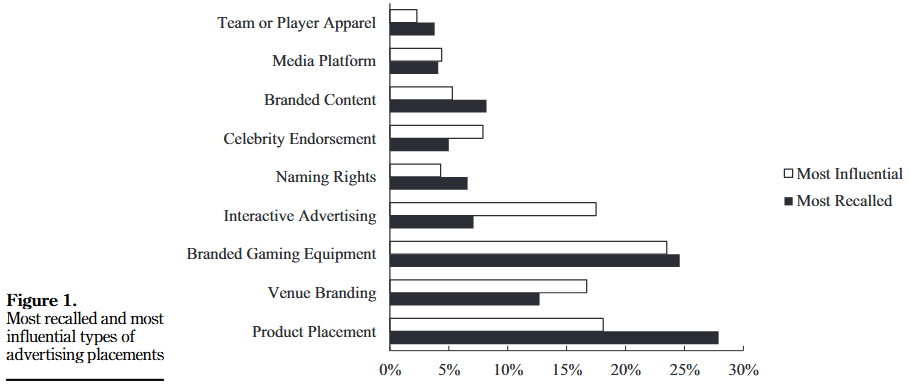
It’s not surprising that product placements lead the chart. If you see an ad over and over again, it is perceived as “good,” creating the urge to buy it. This is called the mere exposure effect. As the name suggests, mere exposure (how often you see something) creates this effect of a well-perceived product or service.
"Heavy and addicted gamers were more likely to purchase products advertised because of advertising they have seen in games, as well as consume alcohol more often when playing and watching esports..." [1]
Especially those aged 25 to 34 were more likely to purchase an alcohol brand’s product if that brand sponsors an online game they play or watch. Furthermore, they consume alcohol more often when playing or watching esports. Heavy and addicted gamers were also more likely to drink compared to their non-addicted and casual gamer counterparts.
Taken together, the study results “indicat[e] that heavier gamers are more receptive to alcohol-branded advertising than lighter gamers, in terms of awareness, preference, and consumption.” [1]
Have a great week,
Christian 🙂