
Navigating the Risks and Rewards of Playing Multiplayer Games

Multiplayer games are the most widely played genre of gaming. The study we're looking at today evaluates both the positive and negative aspects of playing them.
• It is estimated that online games will reach 1.3 billion players by 2025.
• Positive factors of playing multiplayer games include cognitive abilities and collaboration skills, motor skills, emotional well-being, enjoyment, and social interactions.
• Negative aspects include psychological and emotional distress, escapism and coping, academic decline, sleep disturbances, gaming disorder, and anxiety.
• Gaming may be beneficial when integrated into real-life activities, such as sports, cooking, or work.
• Moderation is key! Excessive gaming can eliminate the benefits.
Multiplayer games are the most dominant force when it comes to game genres. The figure below shows the 15 most popular games of 2023. Multiplayer games make up the majority of the 1.3 billion online players expected by 2025.
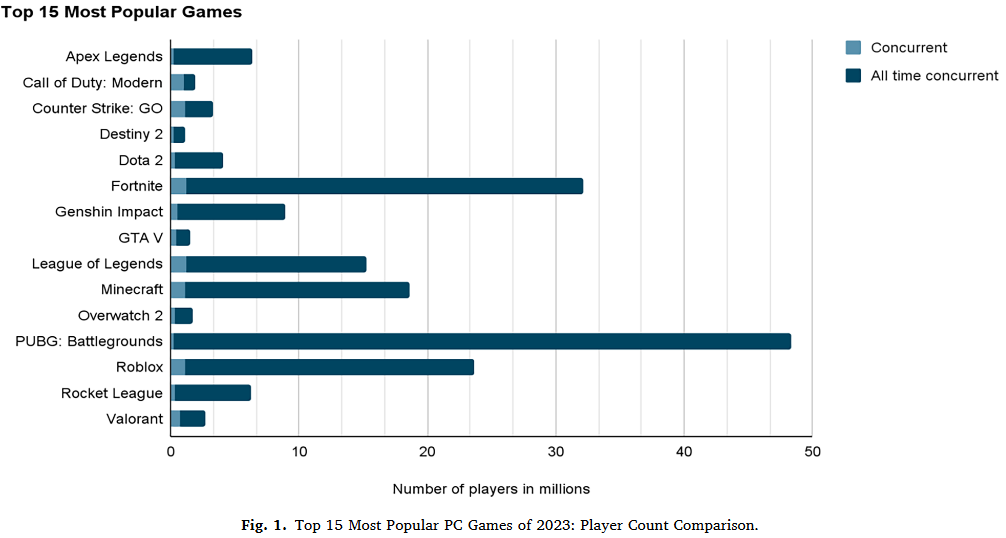
With the increase in games available and rising player numbers, the amount of time players spend in front of the computer has risen as well over the past decade, especially during COVID. When time is spent on an activity, it is worth asking what the return on this investment is.
Every frequent reader of the newsletter knows that gaming has positive and negative aspects. Today's study evaluated these aspects, taking a broader view—rather than focusing on one game, it focused on multiplayer games in general. The goal of the study was to understand the positive and negative impacts of playing multiplayer games.
📊 What are the results?
Let's start with the positives, shall we?
- Cognitive abilities and collaboration skills: This was the most influential factor that emerged from the data. "This finding underscores the significant cognitive benefits that gaming can offer, including enhanced problem-solving and teamwork skills" [1]. This is consistent with other research studies that have found attentional control to be higher among gamers compared to non-gamers.
- Emotional well-being and enjoyment: "Many research papers show the significance of happiness, stress relief, and recreation, indicating that engaging in the activity under study has a notable impact on individuals’ emotional well-being and overall enjoyment" [1]. Every gamer (except maybe those who play LoL and DotA) knows that playing games is fun. They engage us emotionally and can contribute to our well-being by helping us relieve stress by shifting our focus to something enjoyable.
- Motor skills and attentional control: Numerous studies consistently find that gamers have superior abilities "in various cognitive tasks such as tracking moving objects, recognizing changes, and task switching" [1]. This makes sense, as we are "trained" to recognize when an opponent in CS sneaks around the corner in our peripheral vision or to track another player or NPC across the screen.
- Social interaction: A different study found that "playing online computer games fosters both online and offline social support, highlighting the potential of gaming as a platform for social interaction and relationship building" [1]. A frequent player of multiplayer games will inevitably interact with others, likely making friends or at least meeting acquaintances. Some of them will play together more often and even discuss real-life topics. Considering the growth and usage of tools such as Discord, it is clear that communities have, to a significant degree, shifted to the online space.
Now, let's take a look at the negative outcomes of playing multiplayer games.
- Psychological and emotional distress: "These results align with existing research linking gaming habits to adverse mental health outcomes" [1]. For instance, maladaptive cognitions, loneliness, and social anxiety all appear to contribute to the relationship between the amount of time spent playing and the occurrence of Internet gaming disorder—where gaming becomes addictive. Another study showed that being addicted to video games is related to feelings of loneliness [2]. Additionally, extensive gaming is associated with anxiety and sleep disturbances.
- Escapism and coping mechanisms: Fleeing into a virtual world for stress relief may be acceptable, but it can turn negative when used to escape life's major problems. Using gaming as a tool to escape from stress every day and emotional difficulties makes it a negative (maladaptive) coping mechanism. Essentially, when you play a game to distract yourself from dealing with real-world problems, it's very similar (from a behavioral standpoint) to someone who drinks every day.
"According to the findings of this study, it is estimated that 10 % of the participants in the sample are deemed susceptible to developing Internet Gaming Disorder (IGD)" [1].
- Technology-induced academic decline: Findings from some studies suggest there is a negative correlation between gaming and academic performance. In plain English: playing games is likely to worsen your GPA (performance in school or college). As a chain reaction, it then may reduce the odds of getting into the college or job you want.
🥡 The Takeaways
Overall, gaming has positive aspects. However, to gain real-world benefits, you must actively apply them. For instance, improved abilities in tracking objects or attentional control can be advantageous for athletes or police officers (tracking a ball, person, or any other object of interest, or noticing someone approaching you in your peripheral vision). Enhanced motor skills and hand-eye coordination can be beneficial for chefs or cooking in general.
However, if you overdo it, gaming can have negative consequences that, in my opinion, do not justify the benefits. Moreover, the benefits mentioned above can be obtained from other activities (e.g., cooking or reading a book). But I understand, playing games is more fun. As a rule of thumb: moderation is key!
Thanks for reading, and I hope you all have a great week. Cheers,
Christian 🙂