Loot Boxes—Emotions, And Why We Buy
Purchasing loot boxes does not only have an effect on your bank account but also on your emotions. Today's study highlights what gamers feel when opening loot boxes and what elements of them drive higher purchases.
• Loot box characteristics: eye-catching visual and sound effects, near-misses, randomness of results, profit expectations, and non-skill requirements.
• Loot boxes are called a gateway to other forms of gambling and likely contribute to the rising demand for psychological treatment.
• 31% of adolescents (11–16 years) had already bought loot boxes at least once; for adults, it was 78%.
• On average, study participants spent 18.05€ per month on loot boxes, with adolescents spending significantly more than adults.
• "... not obtaining the desired item predicted feelings of distress and guilt in the players, while obtaining the desired item predicted greater feelings of loss of control among the participants." [1]
In an earlier episode, we talked about loot boxes—you know, the gambling-like in-game purchases that contain in-game items. Each item has an (unknown) odds ratio tied to it. Loot boxes have, therefore, been described as a gateway to other forms of gambling. It's not surprising that studies have already shown that “players obtaining more loot boxes are more likely to play other games of chance.” [1]
"Focusing on electronic sports or eSports (massive online games)... a positive link between betting on these competitions and a greater purchase of loot boxes [was found]." [1]
The characteristics of loot boxes make them very attractive to people, including eye-catching visual and sound effects, near-misses, randomness of results, profit expectations, and non-skill requirements.
At the same time, the demand for psychological treatment related to pathological gambling has sharply increased. I bet you can already see where this is going—loot boxes may contribute to that. Since most gamers are adolescents and young adults, they are more exposed to games, loot boxes, and advertisement. For instance, 31% of adolescents (11–16 years) had already bought loot boxes at least once; for adults, it was 78%.
In traditional gambling, players often report feelings of guilt, a loss of control, and a sense of distress. These psycho-emotional elements may, since loot boxes are considered a form of gambling, also be apparent in gamers. This would pose a negative effect on society’s health system. To find out if this is the case, the study wanted...
"1) To analyze the effects of excessive loot box use on the psycho-emotional health of gamers [, and] 2) analyze the use of loot boxes among players and examine variables that may be related to higher spending."
In total, data from 475 Spanish players were analyzed. Participants were 65.05% male and 34.95% female. “The sample was divided into two groups: adolescents (11–18 years) and adults (aged over 18 years).”
🎰 Take My 18.05€ And Leave Me Alone
On average, study participants spent 18.05€ per month on loot boxes. There was a significant difference between adolescents and adults: adolescents spent 21.84€ on average, and adults 15.04€. Not surprisingly, when the participants were divided by the number of hours they played, casual gamers spent, on average, 15.41€ per month, regular gamers 20.17€, and hardcore gamers 20.97€.
"As for the need to buy loot boxes after seeing them advertised on online multimedia platforms, 37% (n = 60) of the participants reported experiencing this, with half of them (n = 30) making such a purchase." [1]
The table below shows the psychological and emotional variables (guilt, loss of control, and perceived distress) associated with the purchase of loot boxes. 71% of adults reported feeling greater guilt after making a purchase.
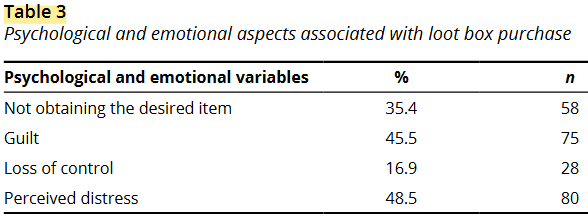
"... not obtaining the desired item predicted feelings of distress and guilt in the players, while obtaining the desired item predicted greater feelings of loss of control among the participants." [1]
That’s interesting, isn’t it? When you don’t get the item you want from a loot box, you feel distress and guilt. However, if you get what you want, you feel like you’ve lost control. So it’s a loss-loss-loss kinda situation? What’s also interesting is that after experiencing such negative feedback from buying a loot box, one could expect people not to do it again—similar to being punished for showing an unwanted desire (if you have a sibling, you know). But this wasn’t the case; quite the opposite, purchasing actually increased.
Thanks for reading, and I hope you all have a great week.
Christian 🙂