Words That Win Rounds: Inside the Communication of Counter‑Strike Pros
Communication is a vital component for teams to perform well. In esports, this is no exception, although it differs slightly due to its virtual nature and lack of nonverbal cues. To perform well, professional teams communicate differently compared to non-professionals. Here's how.
• Communication is an important performance factor, especially in esports.
• The frequency and content of communication differ between professional and non-professional teams in Counter-Strike.
• Professional teams "engaged in more frequent and faster-paced communication... ," meaning more words per minute and talking for longer periods of time.
• Pros use more factual, emotional, and action-oriented communication that changes depending on the outcome of a round (win/loss).
Communication–one of the most important aspects of team games. This is especially true for esports, as most communication happens in a virtual competitive environment. It heavily relies on clear and concise language, because it often completely lacks nonverbal cues. This can lead to misunderstandings.
Communication becomes even more important in fast-paced games such as Counter-Strike. In CS:GO, the team can communicate between rounds for 15 seconds. Using this break is of utmost importance and should be used as productively as possible to increase the odds of winning. However, what exactly does productive mean in this context, and do professional and non-professional teams communicate differently?
The study we'll be discussing today sheds light on these questions. The researchers collected data from 172 between-round communications (1,025 player statements). The content of the communication was categorized as follows:
- Uncertainty (UNC): seeking clarification ("Should I push B site or hold mid?").
- Action (ACT): intended actions or strategies ("I'm flashing A site", "Rotate to B").
- Acknowledgment (ACK): confirming responses that affirm understanding ("Copy", "Got it").
- Factual (FAC): observations about the game state or relevant past encounters ("They've smoked mid", "Enemy last seen near B site").
- Emotional (EMO): expression of emotions or encouragement ("Nice shot!", "Stay calm").
- Non-task (NTS): unrelated to the game or objective ("I need to check my settings").
🗣️ Facts, Actions, and Emotions
First, professional teams "engaged in more frequent and faster-paced communication during the between-round periods than nonexpert teams" [1]. According to the researchers, this suggests a practical advantage in utilizing time efficiently. To put this into numbers: pros spent, on average, 10.1 seconds of the 15-second between-round breaks communicating (67.65%), whereas non-professionals spent only 8.3 seconds (55.31%). On top of that, pros also had a higher pace—4.05 vs. 3.13 words per second.
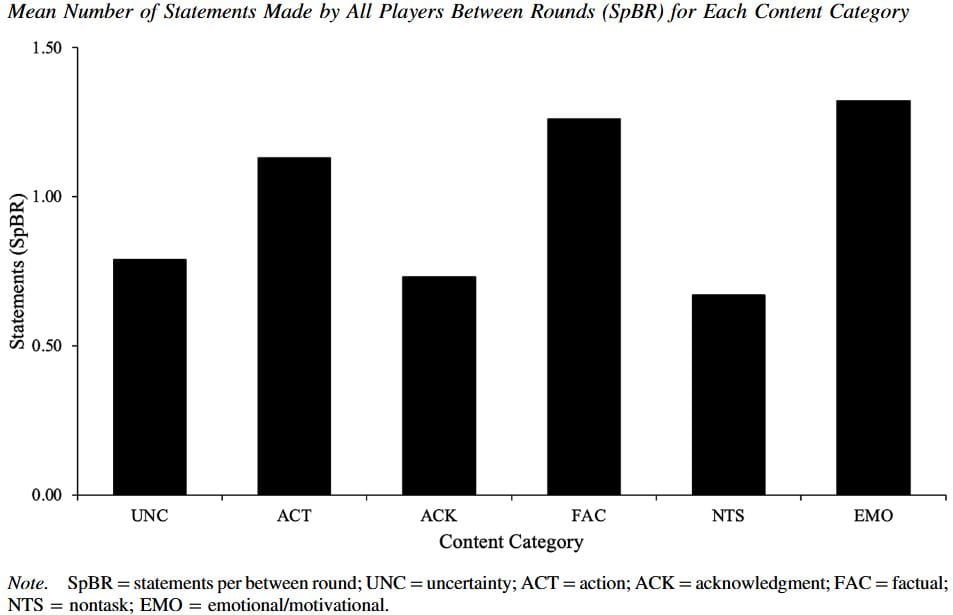
Now, let's look at what both groups talked about. As you can see in the figure below, emotional, factual, and action communication were used the most.
These are the overall numbers, but how did both groups differ?
"...expert players used significantly more ACT oriented, FAC, and EMO statements than nonexpert players." [1]
Emotional communication showed that pros focused on psychological support, whereas...
"The emphasis on ACT and FAC statements illustrates how expert teams actively engage in coordinating tasks and sharing vital information... crucial for coordinated ACT." [1]
This shows, according to the researchers, that professional teams have a clear advantage in maintaining task-focused communication in high-pressure situations. Non-professionals, on the other hand, likely due to their limited experience, used significantly more NTS (non-task-related) communication.
Another interesting finding was that professional "teams adjust their communication content dynamically based on round outcomes" [1]. After winning a round, pros use emotional and factual statements to reinforce morale and confirm a good understanding of the situation. Anyone who’s ever watched a CS tournament knows this—you can see the fist bumps and supportive comments between teammates.
After losing, pros focus on action-oriented communication to adapt and strategize. So, depending on the context (win/loss of a round), they communicate differently. This was different from non-professional teams, who showed less adaptability in their communication regardless of the round outcome. Furthermore, they used more non-task-related statements.
"... expert teams frequently transitioned between ACT-to-ACT statements and balanced these with emotional and ACK statements... The frequent transitions among ACT, emotional, and FAC statements suggest that expert teams actively use information to guide ACTs, address UNCs..." [1]
In contrast, non-professionals transitioned more often between non-task and emotional communication statements. This may indicate that they talk about off-topic or emotional content rather than things relevant to winning (e.g., adapting to the current state of the game).
🥡 The Takeaways
If you want to increase your odds of winning in video games—or just become better at communicating in general—the study offers some key points to focus on. First, don't waste time and be as precise and direct as possible. Avoid off-topic chatter. This becomes even more important after adverse events (when something goes wrong or the topic is serious). Second, encourage others when they do something well (Germans are terrible at this, and Americans overdo it).
Read ya'll next Sunday. Byeee,
Christian 🙂