
The Search For Meaning in Video Games

With the increase in players around the globe came the rise of problematic gaming. As such, an Internet Gaming Disorder (IGD) poses a global health problem that needs to be understood. Today's episode discusses some of the factors that may increase the risk of an IGD. Here's what the research showed.
• Escaping reality, searching for meaning and having a purpose in life, and identifying oneself with in-game avatars are candidates that may increase the risk of an Internet Gaming Disorder (IGD).
• Studies show escapism being related to lower life satisfaction, depression, and loneliness, and avatar identification to excessive gaming and the development of a gaming disorder.
• A lower sense of meaning in life and a higher level of searching for a meaning in life both predicted a higher risk for Internet Gaming Disorder.
• Higher levels of avatar identification and escapism were linked to a higher risk of IGD.
• Indirect relationships were also identified.
In a previous episode, we touched upon the fact that extensive gaming can cause players to develop a problematic relationship with video games (Internet Gaming Disorder – IGD). Studies have shown that problem gamers have increased activation of brain regions associated with craving, addiction, increased depression, impulsivity, low self-control, and many more. Hence, it is important to understand the potential risk factors associated with the development and maintenance of problem gaming.
Some factors are more relevant than others. That's why today's study focuses on escapism, meaning and purpose in life, and the role that avatars in video games play. Let's start by understanding what these terms exactly mean. I highlighted the important snippets in the table below.
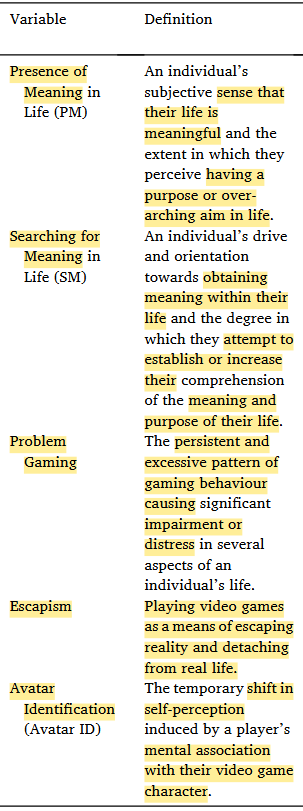
I'd assume that most (if not all) of them are somewhat self-explanatory. With regard to developing problematic gaming or even an Internet Gaming Disorder, escapism is one of the prime candidates: it was found to be related to lower life satisfaction, and...
"Extensive research has suggested that escapism is a core component of problematic gaming behaviour... [as] numerous studies have demonstrated that the escapism mediates the relationship between problematic gaming behaviours and psychological factors including loneliness, depression..." [1]
Avatar identification may be another important factor, because players form a strong emotional bond with their in-game self, where their self-concept fuses with their avatar. "As such, players may use avatars to fulfill specific needs or compensate for deficiencies within their offline life".
As you may expect, avatar identification has already been linked to the motivation for gaming, excessive gameplay, impulsivity, and an increased risk of problematic gaming. But now, let's jump into the results of today's study.
🎰 What are the results?
First, lower scores for purpose in life and higher scores for searching for meaning in life predicted a higher risk of Internet Gaming Disorder (IGD). So, if you feel like you have no purpose in life and are strongly looking for meaning in life, you are at higher risk of becoming addicted to video games. Why? The researchers hypothesize that...
"...individuals who lack and are searching for meaning within their life may resort to gaming to address these deficits." [1]
Next, the relationship between avatar identification and the risk of IGD. They found that the more you identify with your in-game character (avatar identification), the higher the risk of IGD — likely for the same reason. If you have a virtual life (avatar) that you strongly feel attached to, you likely want to progress it. As a result, you play more and longer, which, in turn, increases the odds of becoming addicted.
Probably unsurprising to you by this point is the fact that higher levels of escapism were related to a higher risk of IGD.
Now, it's going to get a liiiittle bit more complicated. But don't worry, you'll get it, I'm sure. There were some mediating relationships:
- Escapism and avatar identification played a mediating role between a higher search for meaning and a higher risk of IGD. What does that mean? In very basic terms, it means that the more someone searches for meaning in life, this impacts escapism and avatar identification, which then, in turn, influence the risk of IGD. In simple terms, it's an indirect relationship (or effect). However, it's not a causal chain.
- A lower purpose in life influenced the level of avatar identification (higher levels), which then influenced (increased) the risk of IGD. The same goes for searching for meaning in life. Again, if you feel like you have no purpose in life while also searching for meaning in life, you may turn towards video games, identify more with your virtual self (avatar), and hence have a higher risk of developing a problem.
- Lastly, "having higher SM was related to higher escapist motives, in turn predicting higher risk for IGD..." [1]
🥡 The Takeaways
Put very simply: if your motive to play video games is to escape real-life problems, you may end up playing more — similar to strongly bonding with your in-game self (avatar). This, in turn, may increase the chance of developing a problematic relationship with video games.
Also, some people may turn towards video games to fill the hole inside themselves — feeling like they have no purpose in life and searching for meaning in life. This will feed into a vicious circle, increasing the risk of playing more and becoming addicted to video games.
Happy week, everyone,
Christian 🙂