
National Diversity: A Challenge to Esports Teams

Is diversity good or bad? A meta-analysis of 50 years of diversity research shows that some aspects have negative consequences for teams. Is national diversity one of them? And does it influence how long an esports team will survive in the industry? Here's the scientific answer.
• 10 years of CS:GO data were analyzed.
• Until 2018, the number of CS:GO teams increased, then fell.
• "Furthermore, a higher degree of internationalization (diversity) increases the risk of failure." [1]
• The higher the attractiveness of the esports industry, the lower the chance of a team failing.
"A common perception is that diversity is beneficial. Diverse team members can complement each other’s skills and knowledge. However, diversity may also increase the cost of coordination." [1]
A classic example of this is language diversity. If your team consists of five players and everyone speaks a different language, then communication is going to be quite hard. Moreover, a study from 2005 analyzing data from 50 years of diversity research concluded that race/ethnicity, gender, and age (among others) "tend to be more likely to have negative effects on the ability of groups to function effectively." [2]
However, some kinds of diversity are good, right? Well, it depends. We know that the national diversity of team members impacts performance in esports. But what about the survivability of esports teams? Do teams with a high degree of national diversity survive longer in esports?
The researchers analyzed about 10 years of CS:GO data (2012 till mid-2021), including prize money among the best 50 teams. The teams were separated by their degree of diversity. For instance, a mononational team would be Astralis, which exclusively consists of players from Denmark. On the other hand, FaZe Clan is a highly international team. They employed 15 different players from 11 different countries across the teams' lifespan.
↔️ More or Less Diversity?
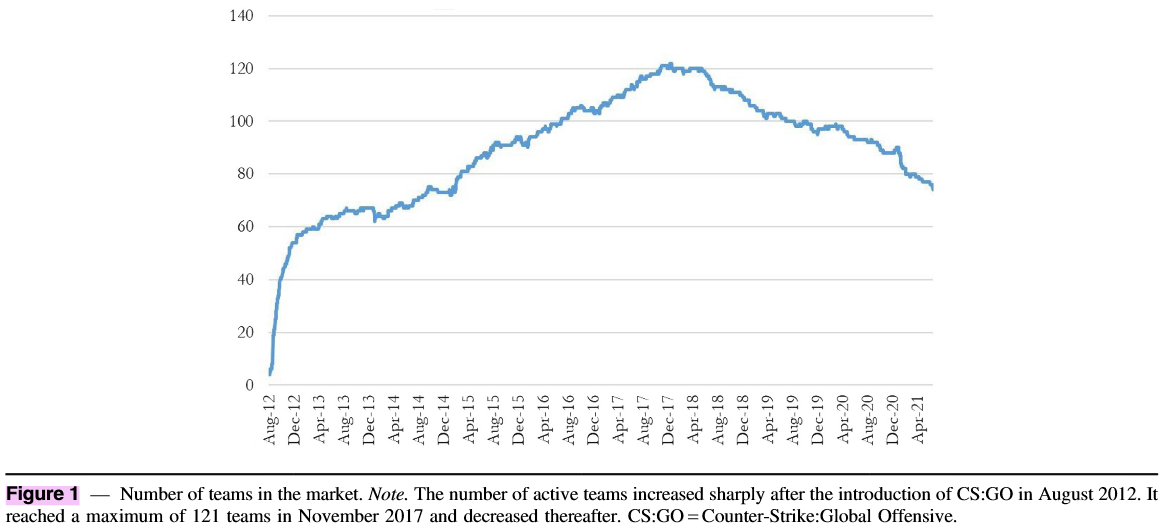
As you can see in the figure above, after the release of CS:GO, the number of teams sharply increased. However, about six years later, it reached its peak and has since declined.
"Furthermore, a higher degree of internationalization (diversity) increases the risk of failure." [1]
What's interesting is their finding that the probability of failure decreased the more competitors are involved. So a higher level of competition lowers the risk of failure. The researchers suggested that the attractiveness of the market makes teams survive longer. However, I don't buy that. It basically comes down to supply and demand. If the market is attractive, more teams will enter the industry. This should, on paper, even out the rate of failure over time. Although, I can see there being an effect over time (the market changes).
I suspect that instead, what happens is the basic notion of the rich get richer. Only a certain number of teams can survive in an industry (or environment in general). Good teams will win more tournaments, get more sponsors, etc. At some point, there will be a cut-off, meaning teams that barely survive. Those who have already been around longer will have, likely, accumulated more resources and have, hence, a better chance of surviving.
Sure, as long as there are sponsorships and tournament prize money available, fewer teams will reach this cut-off point. But when money runs dry, aka the Esports Winter hits, teams start struggling or failing.
Happy week(end).
Christian 🙂